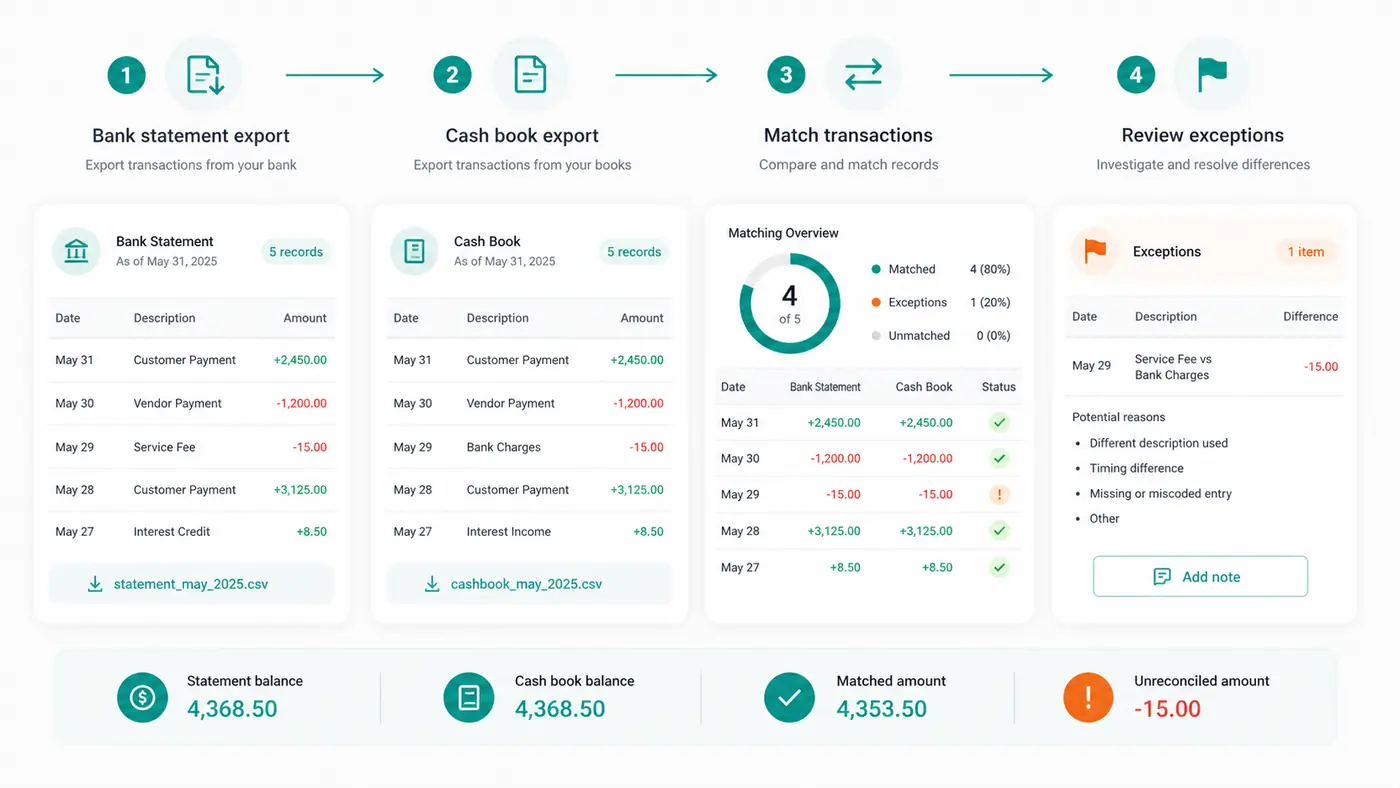
At the end of the month, the cash balance in your accounting records rarely matches the balance on your bank statement exactly.
That does not always mean something is wrong. A customer deposit may still be in transit. A check may not have cleared. The bank may have charged a fee that has not been entered in the books yet. A transaction may have been recorded twice.
Bank reconciliation is the process of comparing a company's internal cash records with its bank statement, identifying the differences, and adjusting the records so the cash balance is accurate.
This guide explains what bank reconciliation means, why it matters, which differences to look for, and how teams can review bank statement files and cash book exports more efficiently.
Unlike a purely accounting-system guide, this article also shows how reconciliation works when the team is still reviewing bank exports, cash book files, and spreadsheet-based exception lists.
Key takeaways
- Accuracy: Bank reconciliation helps confirm whether the cash balance in the books reflects the real bank position.
- Timing: Many differences are caused by timing, such as outstanding checks or deposits in transit.
- Control: Regular reconciliation helps catch duplicate entries, missing fees, bank errors, or unauthorized transactions.
- Process: The core workflow is to compare, explain, adjust, and document the difference.
- Analysis: Teams that already work with bank statement exports and cash book files can use AI to organize exceptions faster.
What is bank reconciliation?
Bank reconciliation is an accounting control that compares two records:
- Bank statement: The bank's record of deposits, withdrawals, fees, interest, and ending balance.
- Cash book or general ledger: The company's internal record of cash transactions.
The goal is to explain why the two balances differ and make the right adjustments.
Some differences are normal. For example, a check recorded in the books may not appear on the bank statement until it clears. Other differences need review, such as duplicate payments, missing deposits, bank fees, or transactions that do not belong to the business.
Bank reconciliation is not just a bookkeeping habit. It is one of the simplest ways to protect cash accuracy.
Why bank reconciliation matters
Cash is one of the most sensitive numbers in a business. If the cash balance is wrong, decisions about payroll, vendor payments, inventory purchases, and cash flow can also be wrong.
Regular reconciliation helps teams answer practical questions:
- Cash accuracy: Does the book balance reflect the actual bank position?
- Missing transactions: Are there bank fees, interest entries, or transfers that have not been recorded?
- Timing differences: Are outstanding checks or deposits in transit causing the gap?
- Duplicate entries: Did the same transaction get entered twice?
- Risk control: Are there unfamiliar withdrawals, unauthorized payments, or possible bank errors?
For finance and accounting teams, the value of reconciliation is confidence. It gives the team a clear explanation for the cash balance before they close the books or make decisions.
Common bank reconciliation terms
Bank reconciliation is easier when the common terms are clear.
| Term | What it means | Why it matters |
|---|---|---|
| Book balance | Cash balance in the company's accounting records | Starting point for internal records |
| Bank balance | Ending balance shown on the bank statement | Starting point for bank records |
| Outstanding check | A check recorded in the books but not cleared by the bank | Explains why the book balance may be lower |
| Deposit in transit | A deposit recorded in the books but not yet shown by the bank | Explains why the book balance may be higher |
| Bank fee | A fee charged by the bank | Often needs to be added to the books |
| Interest income | Interest credited by the bank | Often needs to be recorded in the books |
| NSF check | A customer check returned for insufficient funds | Requires reversal or follow-up |
These terms are not just definitions. They are the labels teams use to explain why the two balances do not match.
The bank reconciliation process
The exact process varies by accounting system, but most teams follow the same logic.
- Collect: Gather the bank statement, cash book, general ledger, and transaction exports for the same period.
- Compare: Match deposits, withdrawals, transfers, checks, fees, and interest between the bank and book records.
- Identify: List transactions that appear in one record but not the other.
- Classify: Separate timing differences from errors, fees, duplicate entries, or unusual transactions.
- Adjust: Record required book adjustments, such as bank fees, interest, or returned checks.
- Document: Keep a reconciliation summary showing the starting balances, differences, adjustments, and reconciled balance.
- Review: Have high-value or unusual exceptions checked by the right person before closing the period.
The process is successful when every material difference has a clear explanation.
Common reconciliation differences
Most reconciliation work comes down to a few repeat patterns.
- Outstanding checks: A payment is recorded in the books, but the bank has not cleared it yet.
- Deposits in transit: A deposit is recorded internally, but the bank statement does not show it yet.
- Bank fees: The bank charges a service fee that has not been entered in the accounting records.
- Interest earned: The bank credits interest that has not been recorded in the books.
- NSF checks: A customer payment is reversed because the payer did not have enough funds.
- Duplicate entries: A transaction appears twice in the cash book or imported file.
- Incorrect amount: The bank and book records show the same transaction with different amounts.
- Unfamiliar transaction: A withdrawal, transfer, or payment needs review before it can be classified.
A simple exception review can look like this:
| Difference | Example | Common treatment |
|---|---|---|
| Outstanding check | Book shows $2,400 payment; bank does not show it yet | Keep as timing difference until cleared |
| Deposit in transit | Book shows $5,200 deposit; bank posts it next period | Add to bank-side reconciliation |
| Bank fee | Bank charges $35 monthly fee | Record fee in the books |
| Interest income | Bank credits $18 interest | Record income in the books |
| Duplicate entry | Same payment imported twice | Remove or reverse duplicate |
This is why bank reconciliation should happen regularly. The longer exceptions sit unresolved, the harder they are to explain.
A simple bank reconciliation example
Imagine a retailer is closing May. The accounting records show a cash book balance of $24,870. The May bank statement shows an ending bank balance of $22,415.
At first glance, the difference looks like a cash problem. After review, the team finds four normal reconciliation items and one item that needs action.
| Item | Amount | How to treat it |
|---|---|---|
| Outstanding vendor check not yet cleared by the bank | $2,400 | Subtract from the bank statement side |
| Customer card deposit recorded in books but posted by bank on June 1 | $5,200 | Add to the bank statement side |
| Monthly bank service fee not recorded in books | $35 | Subtract from the book balance |
| Interest income credited by bank but not recorded | $18 | Add to the book balance |
| Duplicate cash book entry from an import | $362 | Remove or reverse after review |
A simple bank reconciliation statement might look like this:
| Reconciliation line | Amount |
|---|---|
| Bank statement ending balance | $22,415 |
| Add: deposit in transit | $5,200 |
| Less: outstanding check | ($2,400) |
| Adjusted bank balance | $25,215 |
| Cash book balance before adjustments | $24,870 |
| Less: bank service fee | ($35) |
| Add: interest income | $18 |
| Add back: duplicate entry reversal | $362 |
| Adjusted book balance | $25,215 |
Now both sides reconcile to $25,215.
This is the part many short articles skip. The question is not only "what is bank reconciliation?" The useful question is: which differences are timing issues, which require book adjustments, and which deserve human review?
In this example, the outstanding check and deposit in transit explain timing. The fee and interest require accounting entries. The duplicate import is an operational data issue. That last category is where messy files often slow teams down.
A simple bank reconciliation workflow
Teams can improve reconciliation before they rebuild their accounting stack.
- Export: Download bank statement transactions for the period.
- Add books: Export cash book, general ledger, or accounting transaction records.
- Standardize: Check dates, descriptions, amounts, debit/credit signs, and reference numbers.
- Match: Compare transactions by date, amount, reference, payee, or memo.
- Flag: Identify unmatched deposits, checks, fees, transfers, duplicates, and unusual items.
- Summarize: Group exceptions by type and amount before review.
- Adjust: Record approved book entries and document the final reconciliation.
This is where AI can help if the work is file-heavy. For example, a team can upload Excel, CSV, bank statement exports, or structured accounting files and ask:
- Unmatched transactions: Which bank transactions do not appear in the cash book?
- Timing differences: Which deposits or checks may simply be in transit?
- Duplicate entries: Which transactions appear more than once?
- Fee review: Which bank fees or interest entries need to be recorded?
- Exception summary: What are the largest unreconciled items by amount?
The output may be an exception table, a reconciliation summary, a transaction grouping, or a written action list for review. That makes the article's practical angle different from a traditional accounting definition: it focuses on how teams move from raw files to reviewable exceptions.
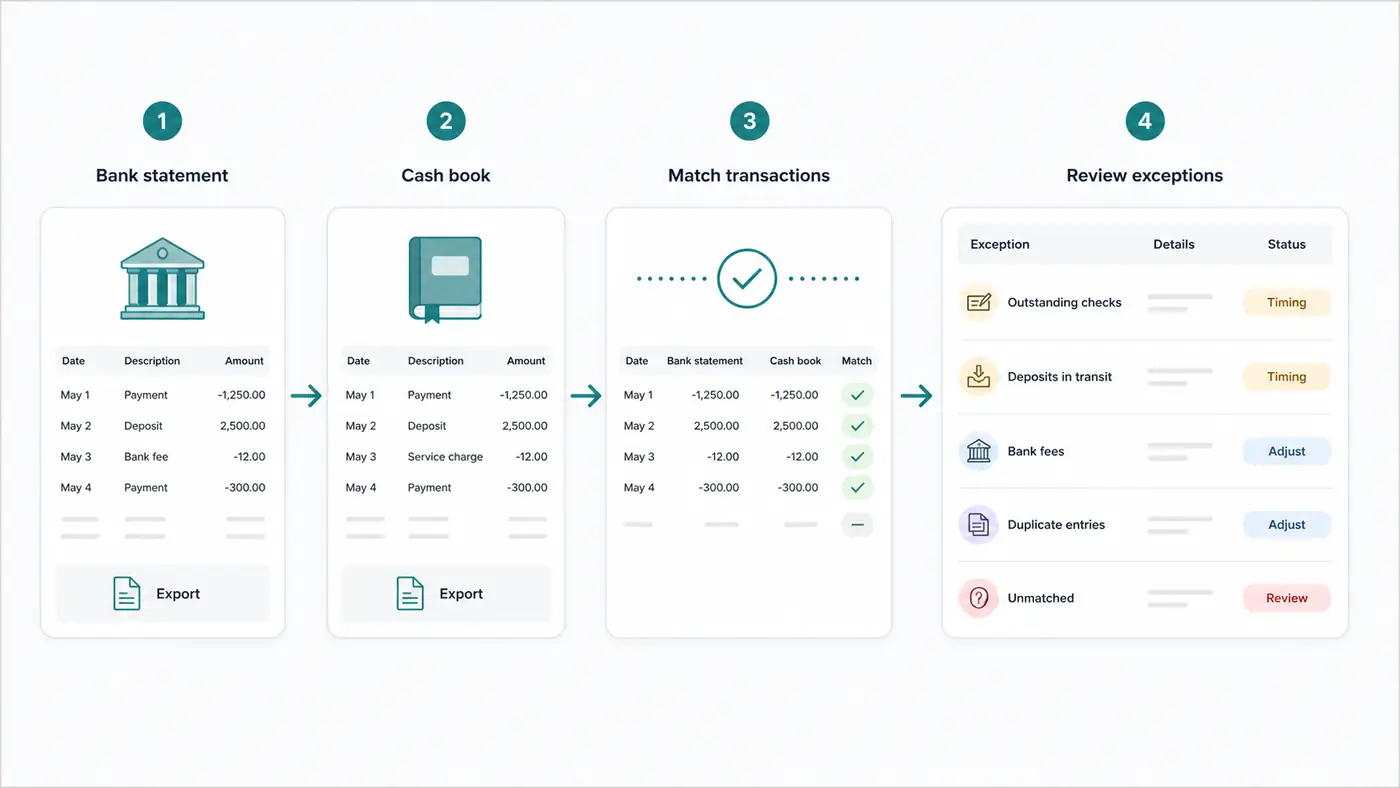
A reconciliation review should make timing differences, missing entries, and unusual transactions easy to inspect.
Before using any report to close the books, run this checklist:
- Period match: Are the bank statement and book records from the same date range?
- Sign convention: Are deposits and withdrawals using the same positive/negative format?
- Duplicates: Have repeated imports or duplicate rows been removed?
- Timing items: Are outstanding checks and deposits in transit separated from true errors?
- Adjustments: Are bank fees, interest, and NSF checks posted to the books?
- Review: Are large or unusual transactions approved by the right person?
Choosing a tool
The right bank reconciliation software depends on the size and complexity of the business.
If the team needs bank feeds, automated posting, approval workflows, and accounting-system controls, dedicated accounting or reconciliation software may be the right fit. If the team already has bank statement exports and accounting files, an AI spreadsheet workflow can help organize the review before a larger system change.
Useful questions include:
- File support: Can the tool work with bank statement exports, Excel files, CSV files, and accounting exports?
- Matching logic: Can it compare transactions by amount, date, description, and reference?
- Exception review: Can it separate timing differences from true errors?
- Ease of use: Can non-technical users ask reconciliation questions in plain English?
- Documentation: Can the team export a summary for review or audit support?
If you are comparing spreadsheet-based AI options, this guide to AI spreadsheet tools can help.
FAQ
What is bank reconciliation in simple terms?
Bank reconciliation means comparing the cash balance in your accounting records with the balance on your bank statement and explaining any differences.
Why do bank and book balances differ?
They often differ because of timing. Outstanding checks, deposits in transit, bank fees, interest, returned checks, duplicate entries, or recording errors can all create differences.
How often should bank reconciliation be done?
Many businesses reconcile monthly, especially before closing the books. Teams with high transaction volume may reconcile weekly or even daily.
What is the difference between book balance and bank balance?
Book balance is the cash balance in the company's accounting records. Bank balance is the balance shown by the bank statement.
Can AI help with bank reconciliation?
Yes. AI can help clean transaction files, group similar items, identify unmatched transactions, flag duplicates, summarize differences, and create review lists. The team should still verify source data and approve final adjustments.
Conclusion
Bank reconciliation gives finance teams a clearer view of cash. It explains why the books and bank statement differ, which items are timing-related, and which items need correction.
For finance and accounting teams, the best starting point is a clean review of bank statements, cash book records, and unreconciled transactions. Once the differences are visible, it becomes much easier to close the books with confidence.
Turn bank statement exports and cash book files into clearer reconciliation review lists with hiData AI Sheets - schedule your demo today.